


 Claim Ownership
A Product Market Fit Show | Startup Podcast for Founders
Subscribed: 79Played: 3,043
Subscribe

© 2025 A Product Market Fit Show | Startup Podcast for Founders
Description
Every founder has 1 goal: find product-market fit. We interview the world's most successful startup founders on the 0 to 1 part of their journeys. We've had the founders of Reddit, Gusto, Rappi, Glean, Cohere, Huntress, ID.me and many more.
We go deep with entrepreneurs & VCs to provide detailed examples you can steal. Our goal is to understand product-market fit better than anyone on the planet.
Rated one of the world's top startup podcasts.
243 Episodes
Reverse

Eric spent 30 years in cybersecurity. Built and sold an MSSP to private equity for hundreds of millions. Then he started Tenex and hit $43 million in revenue in ONE YEAR. This isn't theory. This is a founder who's done it multiple times breaking down exactly how AI-native companies are about to eat every services industry alive. If you're building anything that touches AI, services, or enterprise sales, this is the episode. Why You Should Listen Why selling outcomes beats selling produc...

Carta's Peter Walker is back with the freshest data on what's actually happening at the early stage—and it's not what you're reading on X. While headlines scream about record-breaking rounds, the reality on the ground tells a different story. Seed deals are down. Time between rounds is stretching. And there's a brutal divide between the companies getting all the attention and everyone else. We dig into the exact valuations, graduation rates, team sizes and revenue you need for See...

Alex and his co-founders spent 2018 pitching parking lot owners on computer vision tech. Every meeting ended the same way: "Cute startup, come back in 30 years." So they did something else—they bought the parking operators and implemented the AI themselves. VCs called them delusional. But today, Metropolis has 20 million members and adds 1 million new members every month. Every 1-2 seconds someone signs up. Alex's biggest lesson? When enterprise customers won't adopt your tech, don't co...

Amit walked away from being President of 1-800-Flowers after scaling it from $500M to $2B because he saw smart people trapped in dumb systems. His insight: half of global GDP is 90% manual work—salespeople entering data instead of selling, technicians reading manuals instead of fixing. He started Instalily in Spring 2023 when everyone said AI agents were impossible. Instead of replacing workers, he built AI that finds signals in noise—telling each salesperson exactly which deal to focus...

Wayne tested flight insurance over a single weekend with a WordPress site and Google ads. When people tried to pay, he showed a fake error message. The result: 15.9% conversion. That validation led to Sure, now powering insurance for Tesla, Toyota, and MasterCard. But the journey was brutal. Wayne worked solo for a year, burning through savings in San Francisco. Flew to South Africa for 7 weeks to land his first insurance partner. The real breakthrough came 4 years later, in 2019,...

Matt sold his first company at 19 and made $100K. He sold his second at 21 and made $800K. A couple years later, he launched Clover and grew it to $8M ARR in 6 months. His secret? Insane distribution. His formula is to ignore quality—and engineer quantity instead. While everyone obsesses over viral content, Matt posts 1,000 videos across 333 accounts daily, guaranteeing a million views through pure math. No luck required. He applies the same "volume negates luck" philosophy to eve...

Russ has started and sold multiple companies over 30 years, but his Dynamic Signal journey will change how you think about product-market fit. They had $5M ARR selling influencer marketing software. Then Russ told investors to pretend the $5M didn't exist and bet on a $200K pipeline instead. That pivot led to 600 Fortune 2000 customers and an exit at $50M ARR. Now building his AI measurement startup Larridin, Russ shares why being a repeat founder creates a different problem—every...

Harish spent 9 months building Deliver and could barely get 10 customers. The product worked. Merchants liked the fast delivery promise. But nobody was signing up. Then he made two changes—and scaled to $100M in revenue in 2 years. Shopify acquired them for over $2B. Harish says it wasn't about finding product-market fit. It was about finding product-PRICE-market fit. The product was fine. The pricing model was killing them. This episode breaks down why pricing often isn't just a busine...

Dheeraj built Nutanix into a $20B public company—then walked away to start DevRev. He just raised a $100M Series A. This episode breaks down why most founders "sell and run" (chase new logos instead of delivering value), why that strategy fails, and how Dheeraj thinks about building platforms with use cases instead of just features. He explains why the biggest opportunities come from bundling and why you need to hit 130%+ NRR to scale in B2B. Dheeraj also shares the two near-death experiences...

Amar is a 5x founder who helped birth Tinder (it was the 10th project—after the first 9 failed), then sold his next company to Ford for putting a platform in every single vehicle they make. But the wildest part? He got Ford to commit in under a year by doing something most founders would never do: he asked for SO MUCH money that only the CEO could approve it. That one move made him "part of the transformational change" instead of a vendor they could ignore. In this episode, Amar breaks down t...
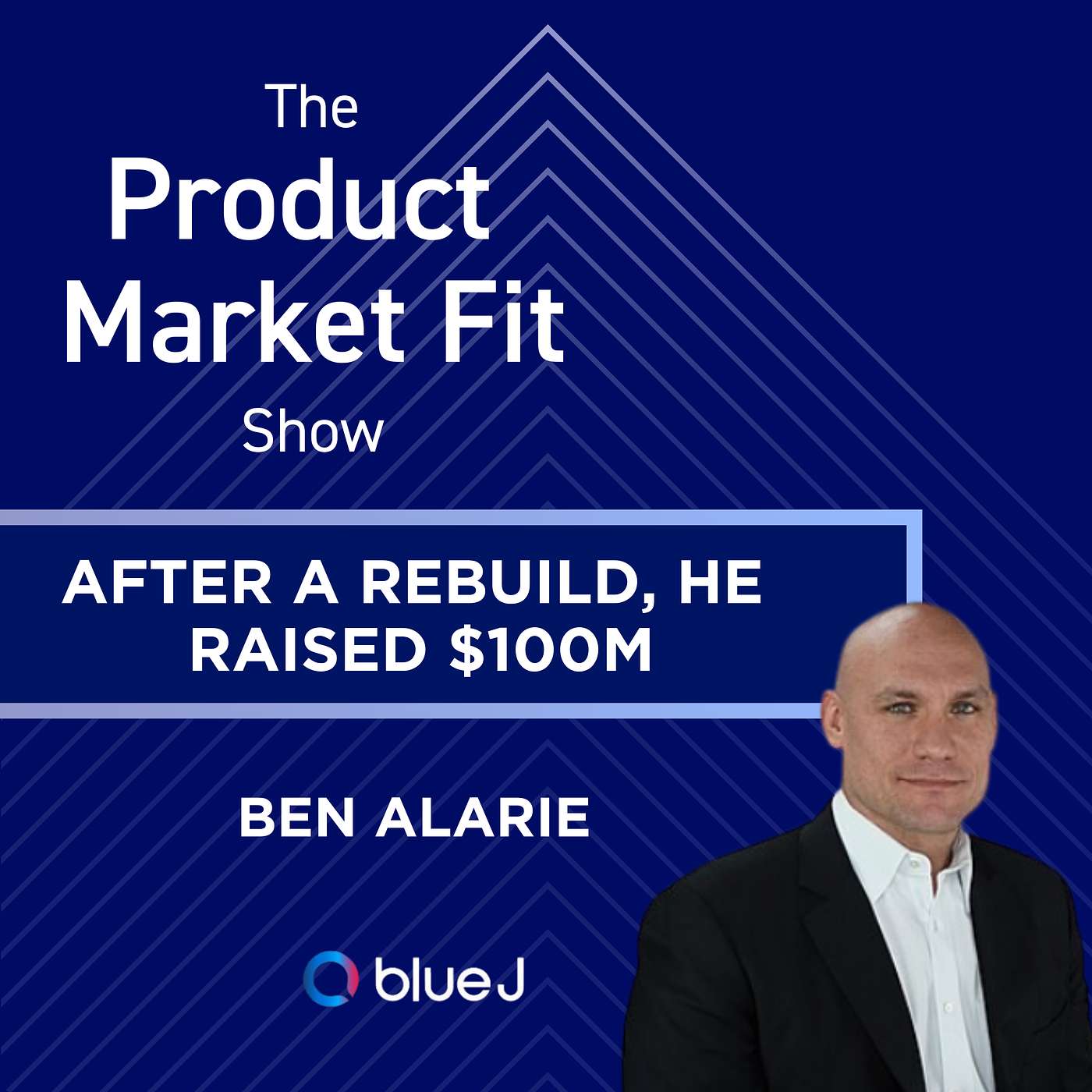
Ben Alarie spent 8 years building Blue J with "partial product market fit"—real customers, real revenue, but no real market pull. Then he made a bet that would either kill the company or 10x it: he put the existing product in maintenance mode and gave his team 6 months to rebuild everything from scratch using a technology that barely worked. Two years later, Blue J went from $2M to $25M in ARR. They're adding 10 new customers every single day. NPS went from 20 to 84. This isn't a story about ...

Dean thought he'd have to bootstrap Axonius because no investor would fund a solution to a problem that had existed for 20 years. He was wrong—they've raised $500M. The breakthrough came when a Fortune 500 company was actively being hacked by Chinese state actors. Their first customer almost said no—they had 20 bugs during the POC. But Dean's team fixed each one within 48 hours while their competitors took quarters to respond. That speed changed everything. They went from zero to ...

Casey turned hackers into a marketplace and built Bugcrowd to $180M+ raised. But the real story isn't about cybersecurity—it's about how he validated a two-sided marketplace with almost no product, refined his pitch by literally testing it on Uber drivers until it clicked, and cracked the code on category creation when everyone thought hackers were the enemy. You'll learn about the exact moment he knew he had product-market fit, why he blew every pitch to top VCs until he reframed...

Zach spent 8 years at Google leading engineering for Google Docs, then left to build a photo sharing app with zero go-to-market plan. Reality hit hard: "At Google, anything you launch gets millions of users. At a startup, the challenge isn't building—it's getting anyone to care." After writing a brutal postmortem documenting everything that went wrong, he started Warp with strict principles: only hire product-obsessed people, document every process, build pure software not services.&nbs...

Alex had $2,000 in his checking account when Microsoft acquired his last company. For years, he paid himself $30K while his friends made six figures at corporate jobs. He had only 2 months of runway for 18 straight months. Then retail media exploded and everything changed—he went from grinding against the current to riding a wave. After selling to Microsoft, he took 6 months off, got bored, and started Bluefish AI with the same team. This time they called Fortune 500 CMOs before buildin...

Brett had a drug dealer's car for 13 days. By day 11, the death threats started coming. This is the reality of building ServiceUp, the "DoorDash for auto repair." Brett literally stole DoorDash's entire playbook—city launches, three-sided marketplace, everything—but discovered even if he got 90% right, 10% of B2C customers can end you. He raised from Tiger just as the firm exploded. The DoorDash partnership that seemed like salvation turned into their worst nightmare. But then th...

Doug Scott and the Ethic team spent years building technology before landing real customers. While other startups were growing fast, Ethic was focused on building, and after two years had only a modest amount of AUM. Until he and his team found a way to help his customers help them WIN new clients they couldn't land before. That shift took them to ~$250M AUM in one year. He reveals why he left investment banking in Australia, sold everything, and moved to the Bay Area within three weeks with...

Arnold Schwarzenegger mastered three completely different fields—bodybuilding, acting, and politics—with one simple philosophy: reps, reps, reps. This solo episode reveals why speed of execution is the only real moat for early-stage founders. One founder takes an idea from conception to signed customers in three weeks. Another takes six months. They both had equally good ideas, but one got 100 reps in a year while the other got 10. Even Twitter, an established app, became top 5 in the A...

Aviv spent months walking construction sites carrying tools for managers just to understand their problems—speaking to customers is "bullsh*t"—you need to work beside them to see reality. His company Buildots had a working AI product that tracked construction progress perfectly, but 90% of users got zero value from it. Until he made one key change that took them from barely surviving to 3-4X yearly growth. He reveals why his first customers had negative margins, how he accidentall...

Shensi cold messaged 50,000 engineers to build Merge. She worked 9am-9pm every day, gave her first customers two months free to prove herself, and refused to hire anyone remote—even during peak COVID. She purposefully didn't collect a single dollar of revenue until she knew she could hit $1M in a months. "Startups are all about momentum." She lost their biggest deal to a competitor who copied them, then won that customer back years later. She outbounded her way from zero to $10M t...


Download from Google Play

Download from App Store
 United States
this is a great podcast. in my journey as an early entrepreneur, such fundamental concepts and viewpoints shine a light at the end of those dark corners you will encounter. keep going!